
Save the Little Fish

Bucephalandra, Bucephalandra

Plant · Rhizome

Bucephalandra

Bucephalandra · Borneo · also Buce

Photo: Manuel Werner, CC BY 4.0, via Wikimedia Commons

Glue or tie it to rock or wood like anubias; burying the rhizome rots it. It grows very slowly, so keep light moderate to stop algae covering the leaves, and expect many named forms that look different.

At a glance

Light

Low light

CO₂

No CO₂

Growth

Slow growth

Where it goes

On wood, rock

Temperature

20–26°C

pH

5–7

Height in a tank

5–10 cm 2–4 in

Difficulty

Easy

What it does for your tank

Small, colourful leaves that suit nano tanks and rocky scapes and give shrimp a grazing surface.

Fish that eat or uproot it

Almost nothing eats it, though pieces can be knocked loose by digging fish.

Growing more

Cut the rhizome into pieces with a few leaves each.

Grows well with

Same light and temperature, but a different spot in the tank, so they fill it out together.

Amazon frogbit

Amazon frogbit

Plant · FloatingEasy

  • Low light
  • No CO₂
  • Fast growth
  • Floats
  • 20–27°C

Long dangling roots shelter fry, bettas and gouramis, and the plant soaks up nitrate fast.

Central and South America

Amazon frogbit

Limnobium laevigatum

Central and South America

Temperature
20–27°C
pH
5–8
Height
2–6 in · 5–15 cm
Light
Low
CO₂
Not needed
Growth
Fast
Goes
Floating
Difficulty
Easy

More plants. Sends out runners with new plants that break off on their own.

Goldfish and some snails eat the spongy leaves; strong filter flow pushes it under and kills it.

Photo: Cardex, Public domain
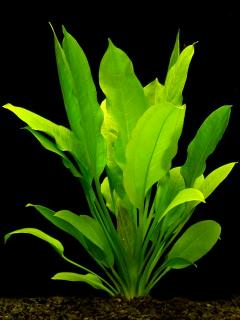
Amazon sword

Amazon sword

Plant · RosetteEasy

  • Low light
  • No CO₂
  • Steady growth
  • Middle
  • 20–28°C

A big, classic centrepiece whose broad leaves give shade and are used by angelfish and other egg-layers for spawning.

Central and South America

Amazon sword

Echinodorus grisebachii 'Bleherae'

Central and South America

Temperature
20–28°C
pH
6–8
Height
8–20 in · 20–50 cm
Light
Low
CO₂
Not needed
Growth
Medium
Goes
Middle
Difficulty
Easy

More plants. Baby plants grow on long flower stems; let them root, then cut them free and plant them.

Goldfish, silver dollars and large cichlids tear or uproot it, and some plecos rasp holes in the leaves.

Photo: Salvatore vitale, Public domain

Cryptocoryne wendtii

Cryptocoryne wendtii

Plant · RosetteEasy

  • Low light
  • No CO₂
  • Steady growth
  • Middle
  • 22–28°C

A hardy low-light plant whose leaves give cover to bottom fish and shrimp.

Sri Lanka

Cryptocoryne wendtii

Cryptocoryne wendtii

Sri Lanka

Temperature
22–28°C
pH
5–8
Height
4–12 in · 10–30 cm
Light
Low
CO₂
Not needed
Growth
Medium
Goes
Middle
Difficulty
Easy

More plants. Sends out runners under the gravel; dig up the new plants and replant them.

Rarely eaten, but goldfish, big cichlids and digging fish can uproot it.

Photo: Haplochromis, CC BY 2.5

Duckweed

Duckweed

Plant · FloatingEasy

  • Low light
  • No CO₂
  • Fast growth
  • Floats
  • 6–30°C

Shades the tank, gives fry cover and soaks up nitrate.

Nearly worldwide, including Canada

Duckweed

Lemna minor

Nearly worldwide, including Canada

Temperature
6–30°C
pH
6.5–8
Height
0.4–0.8 in · 1–2 cm
Light
Low
CO₂
Not needed
Growth
Fast
Goes
Floating
Difficulty
Easy

More plants. Each tiny leaf splits into new plants on its own.

Goldfish, koi, silver dollars and many other plant-eating fish eat it.

Photo: Kostka Martin, CC0

← All plants