
Save the Little Fish

Hornwort, Ceratophyllum demersum

Plant · Stem

Hornwort

Ceratophyllum demersum · Worldwide, including Canada · also Coontail, Rigid hornwort

Photo: S.Tanaka, Public domain, via Wikimedia Commons

It has no real roots, so let it float or weigh the stems down lightly. It grows fast and soaks up nutrients, which helps fight algae, but it can shed lots of needles after a move or a big temperature change, so trim and scoop the loose bits.

At a glance

Light

Low light

CO₂

No CO₂

Growth

Fast growth

Where it goes

Back

Temperature

10–30°C

pH

6–9

Height in a tank

20–80 cm 8–31 in

Difficulty

Easy

What it does for your tank

A thick, fast hiding place for fry and shrimp that helps keep nitrate and algae down.

Fish that eat or uproot it

Goldfish, silver dollars and big cichlids will graze it, but its stiff needles keep most fish off.

Growing more

Snap off a piece of stem and let it float or push it into the gravel; it branches on its own.

Grows well with

Same light and temperature, but a different spot in the tank, so they fill it out together.

Amazon frogbit

Amazon frogbit

Plant · FloatingEasy

  • Low light
  • No CO₂
  • Fast growth
  • Floats
  • 20–27°C

Long dangling roots shelter fry, bettas and gouramis, and the plant soaks up nitrate fast.

Central and South America

Amazon frogbit

Limnobium laevigatum

Central and South America

Temperature
20–27°C
pH
5–8
Height
2–6 in · 5–15 cm
Light
Low
CO₂
Not needed
Growth
Fast
Goes
Floating
Difficulty
Easy

More plants. Sends out runners with new plants that break off on their own.

Goldfish and some snails eat the spongy leaves; strong filter flow pushes it under and kills it.

Photo: Cardex, Public domain
Amazon sword

Amazon sword

Plant · RosetteEasy

  • Low light
  • No CO₂
  • Steady growth
  • Middle
  • 20–28°C

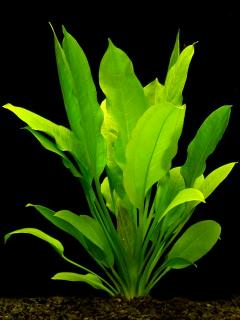
A big, classic centrepiece whose broad leaves give shade and are used by angelfish and other egg-layers for spawning.

Central and South America

Amazon sword

Echinodorus grisebachii 'Bleherae'

Central and South America

Temperature
20–28°C
pH
6–8
Height
8–20 in · 20–50 cm
Light
Low
CO₂
Not needed
Growth
Medium
Goes
Middle
Difficulty
Easy

More plants. Baby plants grow on long flower stems; let them root, then cut them free and plant them.

Goldfish, silver dollars and large cichlids tear or uproot it, and some plecos rasp holes in the leaves.

Photo: Salvatore vitale, Public domain

Anubias barteri

Anubias barteri

Plant · RhizomeEasy

  • Low light
  • No CO₂
  • Slow growth
  • On wood, rock
  • 22–26°C

Tough leaves give shade and spawning spots and survive plecos and cichlids.

West Africa (Nigeria, Cameroon, Bioko)

Anubias barteri

Anubias barteri var. barteri

West Africa (Nigeria, Cameroon, Bioko)

Temperature
22–26°C
pH
6–7.5
Height
10–18 in · 25–45 cm
Light
Low
CO₂
Not needed
Growth
Slow
Goes
On wood or rock
Difficulty
Easy

More plants. Cut the rhizome into pieces with a few leaves each.

Herbivorous fish leave its tough leaves alone; big cichlids may uproot it.

Photo: Tocekas, CC BY-SA 3.0

Anubias nana

Anubias nana

Plant · RhizomeEasy

  • Low light
  • No CO₂
  • Slow growth
  • On wood, rock
  • 22–28°C

Tough, low leaves that bottom fish and plecos rest on and that do well in shady corners.

West Africa (Cameroon)

Anubias nana

Anubias barteri var. nana

West Africa (Cameroon)

Temperature
22–28°C
pH
5–8
Height
2–6 in · 5–15 cm
Light
Low
CO₂
Not needed
Growth
Slow
Goes
On wood or rock
Difficulty
Easy

More plants. Cut the rhizome into pieces with a few leaves each.

Almost nothing eats it, so it is a top choice for cichlid, goldfish and pleco tanks.

Photo: Krzysztof Ziarnek, Kenraiz, CC BY-SA 4.0

← All plants