
Save the Little Fish

Vallisneria, Vallisneria spiralis

Plant · Grass-like

Vallisneria

Vallisneria spiralis · Europe, North Africa and Asia · also Eel grass, Tape grass, Straight vallisneria; related: Vallisneria americana (jungle val), Vallisneria gigantea

Photo: Lamiot, CC BY-SA 4.0, via Wikimedia Commons

Plant it with the white crown just at the gravel surface, not buried. Leaves often melt for a few weeks after planting, then new ones grow; the bigger species such as V. americana can reach a metre and need a tall tank.

At a glance

Light

Low light

CO₂

No CO₂

Growth

Fast growth

Where it goes

Back

Temperature

20–28°C

pH

6–8

Height in a tank

30–50 cm 12–20 in

Difficulty

Easy

What it does for your tank

Fast tall grass that makes a quick background wall, uses up nitrate and gives fish a calm place to rest.

Fish that eat or uproot it

Goldfish and big cichlids chew it and may uproot it; it also melts with some medicines and liquid carbon.

Growing more

Sends out runners with baby plants; cut them off once they have roots and replant.

Grows well with

Same light and temperature, but a different spot in the tank, so they fill it out together.

Amazon frogbit

Amazon frogbit

Plant · FloatingEasy

  • Low light
  • No CO₂
  • Fast growth
  • Floats
  • 20–27°C

Long dangling roots shelter fry, bettas and gouramis, and the plant soaks up nitrate fast.

Central and South America

Amazon frogbit

Limnobium laevigatum

Central and South America

Temperature
20–27°C
pH
5–8
Height
2–6 in · 5–15 cm
Light
Low
CO₂
Not needed
Growth
Fast
Goes
Floating
Difficulty
Easy

More plants. Sends out runners with new plants that break off on their own.

Goldfish and some snails eat the spongy leaves; strong filter flow pushes it under and kills it.

Photo: Cardex, Public domain
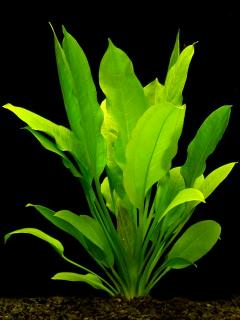
Amazon sword

Amazon sword

Plant · RosetteEasy

  • Low light
  • No CO₂
  • Steady growth
  • Middle
  • 20–28°C

A big, classic centrepiece whose broad leaves give shade and are used by angelfish and other egg-layers for spawning.

Central and South America

Amazon sword

Echinodorus grisebachii 'Bleherae'

Central and South America

Temperature
20–28°C
pH
6–8
Height
8–20 in · 20–50 cm
Light
Low
CO₂
Not needed
Growth
Medium
Goes
Middle
Difficulty
Easy

More plants. Baby plants grow on long flower stems; let them root, then cut them free and plant them.

Goldfish, silver dollars and large cichlids tear or uproot it, and some plecos rasp holes in the leaves.

Photo: Salvatore vitale, Public domain

Anubias barteri

Anubias barteri

Plant · RhizomeEasy

  • Low light
  • No CO₂
  • Slow growth
  • On wood, rock
  • 22–26°C

Tough leaves give shade and spawning spots and survive plecos and cichlids.

West Africa (Nigeria, Cameroon, Bioko)

Anubias barteri

Anubias barteri var. barteri

West Africa (Nigeria, Cameroon, Bioko)

Temperature
22–26°C
pH
6–7.5
Height
10–18 in · 25–45 cm
Light
Low
CO₂
Not needed
Growth
Slow
Goes
On wood or rock
Difficulty
Easy

More plants. Cut the rhizome into pieces with a few leaves each.

Herbivorous fish leave its tough leaves alone; big cichlids may uproot it.

Photo: Tocekas, CC BY-SA 3.0

Anubias nana

Anubias nana

Plant · RhizomeEasy

  • Low light
  • No CO₂
  • Slow growth
  • On wood, rock
  • 22–28°C

Tough, low leaves that bottom fish and plecos rest on and that do well in shady corners.

West Africa (Cameroon)

Anubias nana

Anubias barteri var. nana

West Africa (Cameroon)

Temperature
22–28°C
pH
5–8
Height
2–6 in · 5–15 cm
Light
Low
CO₂
Not needed
Growth
Slow
Goes
On wood or rock
Difficulty
Easy

More plants. Cut the rhizome into pieces with a few leaves each.

Almost nothing eats it, so it is a top choice for cichlid, goldfish and pleco tanks.

Photo: Krzysztof Ziarnek, Kenraiz, CC BY-SA 4.0

← All plants